


9 Things to Do Before December 31
As we head into the last couple of months of the year, I wanted to share a few things worth thinking about before December 31. Most tax moves for 2026 have to be made by year-end, not at tax time in April. Once the calendar turns, the window closes on charitable donations, RESP grants and a handful of other opportunities. The RRSP is the main exception, with a deadline of March 1, 2027.
Below are the nine items I most often see Canadians leave on the table. Not every one will apply to you, so read through and make a note of any that might. If something catches your eye, reach out and we can talk through whether it makes sense for your situation.
The Checklist
1. Make your charitable donations. Gifts must be made by December 31 to count for 2026. Donations above $200 earn the highest combined federal and Ontario credit, so it often pays to group gifts into one year. Donating publicly traded securities in kind, rather than selling first, eliminates the capital gains tax on the growth.
2. Turning 71? Convert your RRSP. Your RRSP must be converted to a RRIF or annuity by December 31 of the year you turn 71. If you still have room, make a final contribution before the conversion. A younger spouse's age can be used to set lower RRIF minimum withdrawals.
3. Time your TFSA withdrawals. Room from a withdrawal is restored on January 1 of the following year. Taking money out in December instead of January gets that room back a full year sooner. The 2027 TFSA limit has not been confirmed by the CRA yet; it is widely expected to rise to $7,500 from $7,000.
4. Capture this year's RESP grant. The federal government adds 20% on the first $2,500 contributed each year, up to $500 per child. Unused grant room carries forward, and you can catch up one extra year at a time. Therefore, it's possible to add $5,000 in a calendar year and receive $1,000 in matching grants. Contributions must be in by December 31 to count for 2026.
5. Open an FHSA, even if you can't fund it yet. First Home Savings Account room of $8,000 a year only starts accumulating once the account is open, up to a $40,000 lifetime limit. Opening one before year-end banks 2026 room for future contributions.
6. Pay deductible and creditable expenses. Medical bills, childcare, investment loan interest and professional fees count in the year they are paid. For medical expenses, you can choose any 12-month period ending in 2026, so look at which window gives the largest claim.
7. Split income with your spouse. If you and your spouse have different incomes, you may be able to save through spousal RRSPs, pension income splitting for those 65 and over, and prescribed-rate loans. The CRA's prescribed rate is 3% for October to December 2026. Interest on an existing prescribed-rate loan must be paid by January 30 or the strategy fails.
8. Retirees: manage income around the OAS claw back. Old Age Security starts being clawed back at 15% once 2026 net income passes $95,323. Large RRIF withdrawals, capital gains or grossed-up dividends can push you over. TFSA withdrawals don't count as income, so they are a useful way to top up cash.
9. Business owners: settle salary, dividends and bonuses. If you own a corporation, it's worth settling your 2026 salary-versus-dividend mix with your accountant before year-end. Salary creates RRSP room and CPP credits; dividends do not. Paying family members a reasonable wage for real work they do is another way to spread income.
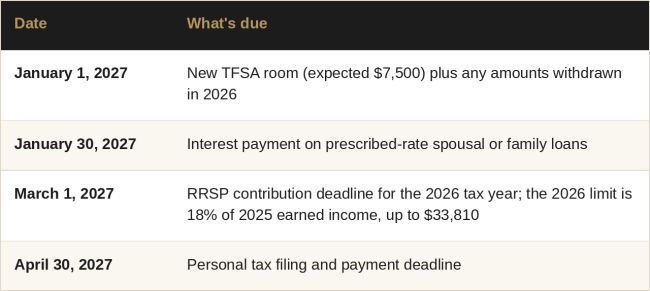
Looking ahead to early 2027
A few dates follow close behind December 31:
Let's talk it through
The best time to act on this list is November, before offices slow down for the holidays. If you have questions about any of these items, or want to go through which ones apply to you, just reply to this email or give me a call. I'm always happy to help!
Talk soon,
Jon